
Desma Pitt, 59, lost her limb after a minor injury worsened due to diabetes complications. What began as a small wound quickly became life-threatening.
“I didn’t even feel the injury at first. Then it started turning black, and I got very sick. The doctors tried to save it, but eventually they had to amputate. I thanked my foot for the 59 years of service it gave me,” she said.
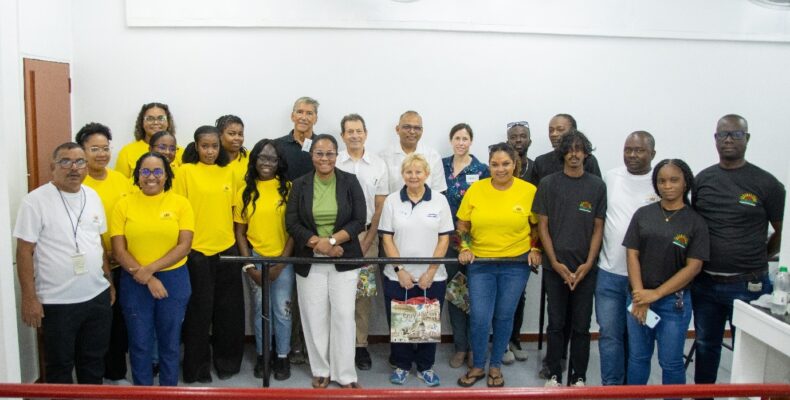
Pitt is among twenty persons who benefitted from an outreach programme over the past week through which the Ministry of Health in collaboration with a team from US-based ProsthetiKa has worked with the Ptolemy Reid Rehabilitation Centre to assess, fit, and train 20 patients in the use of prosthetic limbs while simultaneously strengthening local technical capacity.
After receiving her prosthetic leg during the programme, she described overwhelming excitement.

“I dreamt about walking again. Now I can. I’m so thankful to the team, my children, and everyone who encouraged me. This is another phase of life, and I’m ready for it.”
The Ministry in a statement disclosed that the outreach was completed last week through its Rehabilitation and Disability Services.
Minister of Health, Frank Anthony, noted that the programme represents more than clinical care; it restores livelihoods and social participation.
“These services transform lives. Our goal is not only to provide prostheses but also to ensure patients regain confidence, independence, and the ability to work and care for their families,” the Minister said.
Dr Anthony expressed appreciation for the collaboration, noting that the initiative not only restored mobility but also improved the quality of life for patients.
“Many patients cannot afford prosthetic services, yet these devices transform lives. Through partnerships like this, we are improving accessibility while building our own technical expertise to sustainably serve our population,” the Minister stated.
He further highlighted the importance of prevention, explaining that a significant number of amputations result from complications of diabetes. The Ministry is therefore strengthening multidisciplinary management to reduce future limb loss while expanding rehabilitation services for those already affected.
The US-based organisation of international consultants aims to provide appropriate and sustainable assistance for persons with disabilities in developing countries.
Led by Jon Batzdorff, Certified Orthotist/Prosthetist (CPO) and ProsthetiKa founder, this year’s team also consisted of CPOs John Morales and Meghan Wright, and Clinical Physiotherapist in vascular and amputee rehabilitation, Laura Burges, Clinical Physiotherapist, ProsthetiKa.
Batzdorff commended the Ministry’s policy direction.
“Providing access to prosthetics is a powerful policy because it restores independence and dignity to people’s lives,” Batzdorff said.
He emphasised that the week’s achievements were the result of extensive teamwork and preparation.
“We assessed and fitted 20 patients. Each prosthesis requires assessment, casting, plastic moulding, assembly, and rehabilitation training; it takes a full team to make it happen.”
Batzdorff underscored the critical role of local healthcare workers and trainees who participated in every stage of the process.
“This work would not have been possible without the local team, from mixing plaster to casting and fitting. We didn’t just ask people to watch; we asked them to try.”
A central objective of the programme was sustainability. Rather than creating reliance on visiting specialists, the initiative prioritised empowering local professionals with the knowledge and practical skills necessary to continue providing services independently.

“We are not here to create dependence. We want the skills to stay here so repairs and future prostheses can be done locally, long after we leave.”
Meanwhile, Director of Rehabilitation and Disability Services, Dr Ariane Mangar, stated that the initiative represents a significant advancement in local rehabilitation services. In addition to restoring mobility and independence to 20 persons with amputations, the programme strengthened national capacity through the training of six new prosthetic technicians, an essential investment in sustainable service delivery.
She further noted that, while this milestone is being celebrated, a considerable waiting list of patients remains. The Ministry, therefore, anticipates collaboration with Jaipur Foot, which is expected to support the fitting of approximately 100 additional individuals in the coming months.
“Together, these efforts are not only restoring limbs, but also restoring dignity, productivity, and quality of life for many Guyanese,” she said.
Another beneficiary, Ivor Fordyce, explained that his amputation followed an unnoticed injury caused by a fragment of broken glass while working around his home.
“It started small but spread fast. Within hours, my foot turned black, and doctors had to amputate.”
After being fitted with a prosthetic limb, he now feels hopeful about returning to normal daily activity.
“I don’t like to sit down. Even before this, I tried helping at home. Now I feel better and encouraged. This will help me become independent again and provide for my family.”
He expressed gratitude for the opportunity:
“God bless the whole institution for putting us back on track.”
The post 20 patients get prosthetic limbs, training appeared first on News Room Guyana.
