
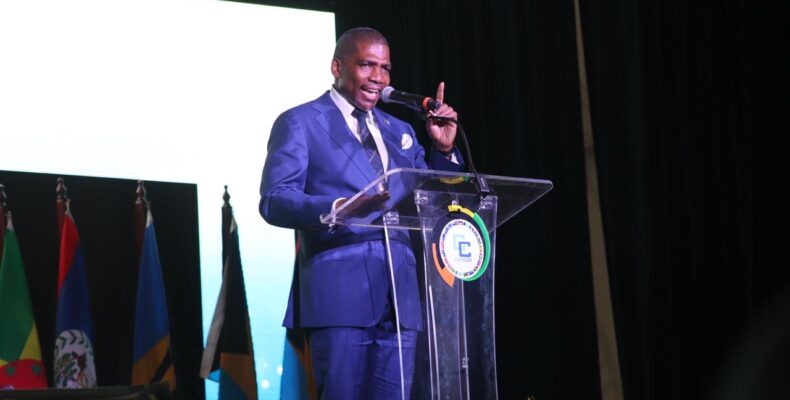
CARICOM’s 50th Heads of Government meeting opened Tuesday with a powerful show of presence. Every full member state represented in the same room for the first time in more than a decade, but beneath the applause, leaders repeatedly asked the same question: can the region truly act together when political and foreign policy fault lines are widening?
Under the theme “Beyond Words: Action Today for a Thriving, Sustainable CARICOM,” new CARICOM Chair Dr Terrence Drew set the tone by insisting that unity cannot stop at speeches and cannot exist only between countries. It must begin at home.
Before the summit, Drew travelled across several Caribbean states and islands, meeting leaders face-to-face. He said those visits deepened his belief that while each country is sovereign and politically distinct, the region’s survival depends on recognizing a simple truth that instability in one place is instability everywhere.
For Drew, that means regional security, energy independence, food systems and humanitarian crises are not optional agenda items; they are shared burdens.

But he went further. He argued that CARICOM cannot demand regional cohesion if its own member states are internally fractured. In St Kitts and Nevis, he said, national priorities like geothermal energy and crime reduction required cooperation between government and opposition not partisan warfare.
Unity, in his words, is not sentimental, It is strategic.
Then came a reality check.
Trinidad and Tobago Prime Minister Kamla Persad-Bissessar reaffirmed her country’s commitment to CARICOM but she openly challenged how unity is practiced.
She raised concerns about what she described as uneven representation within the regional system, saying CARICOM must be the voice for all citizens, not only governing parties. She also criticized what she suggested was political interference across borders, warning that such actions create unnecessary divisions between leaders.
Her message was blunt and insisted that solidarity cannot be selective.
While Drew was calling for national and regional togetherness, Kamla cautioned that some already feel left out of that circle.
The unity question becomes sharper when placed against the region’s most volatile issues.
On Cuba, Drew spoke personally, recalling his years studying there and describing messages from friends about shortages and hardship. A destabilized Cuba, he warned, would affect the entire Caribbean, given its size and geographic reach.
Outgoing Chair Andrew Holness of Jamaica echoed the concern, urging clarity and courage in addressing Cuba’s humanitarian and economic strain. But even here, CARICOM’s internal balance is delicate some leaders emphasize relief and solidarity, others governance and reform.

On Venezuela, Kamla underscored threats facing Guyana and Trinidad and Tobago, questioning how the region can describe itself as a “zone of peace” when member states feel exposed. CARICOM has consistently backed Guyana’s territorial integrity, but political approaches to Caracas differ.
And on Haiti, Drew reminded leaders that instability there reverberates throughout the Caribbean — through migration, trafficking and regional security pressures. The crisis has long unified concern, but converting concern into effective collective action has proven harder.
Holness offered a framing that explains much of the tension and that is that CARICOM is not a political union. Its members are sovereign democracies. They will see risks differently. They will choose different pathways.
Variation, he suggested, is not weakness.
But the question hovering over the hall in Basseterre seemed to be: when does variation become fragmentation?
Drew’s answer is that sovereignty must coexist with responsibility. Yes, each state decides its path. But the region cannot afford to treat crises as someone else’s problem.
Kamla’s counterpoint is that responsibility must run both ways including fairness, accountability and respect within the regional machinery itself.
Drew closed with a warning that “the region will not be judged by its communiqués but by its courage.”
The post Drew calls for ‘togetherness’ at home and abroad as Kamla warns unity can feel uneven appeared first on News Room Guyana.
