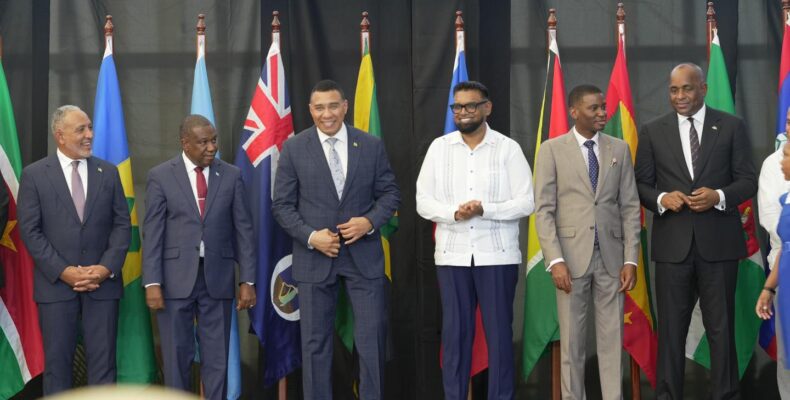
President Dr Irfaan Ali’s participation in the 50th CARICOM Heads of Government Meeting in St Kitts and Nevis was marked less by speeches in the plenary hall and more by strategic diplomacy on the sidelines, most notably a high-level bilateral with United States Secretary of State Marco Rubio.
While President Ali did not address the opening ceremony, he joined regional leaders for Wednesday’s plenary session and held several bilateral engagements, including talks with Trinidad and Tobago’s Prime Minister. However, his meeting with Rubio stood out, given Washington’s sharpened focus on regional security, Venezuela and Cuba.
According to President Ali, the discussions with the US Secretary of State were “very positive” and “purposeful,” centering on strengthening bilateral ties, coordinating on regional security challenges, and aligning development priorities. Venezuela’s posture toward Guyana featured prominently, with Ali welcoming regional support for Guyana’s territorial integrity amid continued tensions.
On Cuba, however, Guyana’s position reflects a nuanced divergence from some of its Caribbean neighbours.

Earlier in the summit, CARICOM Chair Dr Terrence Drew warned that instability in Cuba would have ripple effects across the region, while outgoing Chair Andrew Holness urged clarity and courage in addressing the island’s humanitarian and economic strain. Trinidad and Tobago’s Prime Minister Kamla Persad-Bissessar also signaled broader regional concern about fairness and balance within CARICOM’s responses to external pressures.
Against that backdrop, Ali outlined what he described as Guyana’s “model” approach to engaging Cuba, particularly regarding Cuban medical professionals.
With some Caribbean states facing scrutiny from the United States over payment arrangements for Cuban doctors and nurses, Guyana has opted to hire Cuban healthcare workers directly under its local labour laws. President Ali said those workers are paid within Guyana’s legal framework, on the same conditions as domestic employees, and receive their salaries directly, a structure he believes meets international standards.
“If the Cuban workforce can give us the numbers we need, and we hire them in accordance with our labour laws and regulations, and ensure they are paid within the laws of our country on the same conditions as any other worker, then I think you meet all the international criteria,” he indicated.

While some CARICOM leaders have emphasized solidarity with Cuba in the face of hardship, Ali’s comments suggest a calibrated approach, one that maintains engagement but aligns closely with international compliance expectations, particularly given Guyana’s expanding strategic ties with Washington.
The President also stressed that broader US-Guyana cooperation must extend beyond oil and gas to food security, trade facilitation and regional development frameworks. He described the conversation with Rubio as one of “alignment” on security and development priorities, including Venezuela’s threat posture and the need for coordinated regional responses.
The post At CARICOM Summit, Guyana charts distinct path on Cuba appeared first on News Room Guyana.
